


When the Trump administration violates legal norms or does something unorthodox, people on the other side typically turn to the common refrain, “This is not normal.” In the wake of the ICE shooting in Minneapolis this week, I’m growing extremely worried about what our new “normal” is becoming.
I’ve been closely following the public discourse around the tragic shooting of Renee Good. And I’m not naive about how this all works; I know the pattern well: when incidents like this occur, people quickly dig in, stake out positions, and defend them regardless of what new evidence emerges.
But for some reason, this time feels different, darker, and more dangerous.
Over the past year, this administration has done and said some deeply disturbing and inhumane stuff. The Department of Homeland Security’s social media accounts, for instance, have used memes and disturbing images of people being arrested, chained, and thrown onto airplanes, and have often used dehumanizing language to describe immigrants.
I bring this up because it helps explain why the administration’s response to this shooting feels less like caution and more like continuation — and it has taken on another level of mean-spiritedness.
Normally, when things like this happen, the typical response, especially from federal officials, is reserved. If an administration responds at all, they will say that the events that unfolded were tragic, that authorities are conducting ongoing investigations into what occurred, and perhaps stress that protesters should respond peacefully.
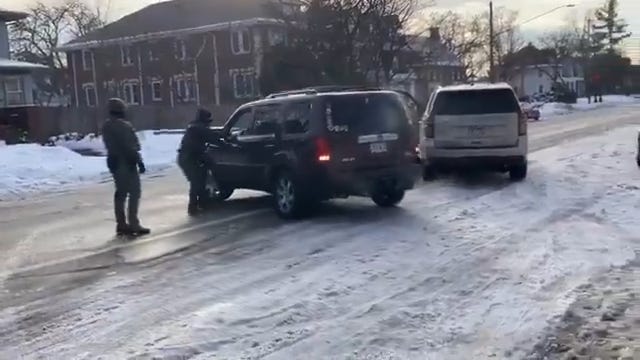
Instead, the administration moved quickly to lock in a narrative about what happened — before the facts were known. Within hours after the incident, Department of Homeland Security Secretary Kristi Noem called Good’s actions “an act of domestic terrorism.” She claimed that officers “were attempting to push out their vehicle and a woman attacked them and those surrounding them, and attempted to run them over and rammed them with her vehicle.” Obviously, none of the video evidence released supports this.
In a press conference, Vice President J.D. Vance was also confident and adamant about what had occurred. Rather than expressing empathy and stressing the need for cooler temperatures, his tone was angry, confrontational, and annoyed. He asserted, without evidence, that Good was “part of a broader left-wing network to attack, to dox, to assault and to make it impossible for our ICE officers to do their job.” He also claimed that she was using “domestic terror techniques.”
When pressed on whether it was premature to draw conclusions about the incident, Vance argued that certain facts were not in dispute: “You have a woman who aimed her car at a law enforcement officer and pressed on the accelerator.” “Nobody debates that,” he insisted, despite the fact that many people, watching the same footage, clearly do.
He continued, “You’ve got to be a little brainwashed to get to that point to where you’re willing, not just to protest, that’s fine — not peacefully protest, but throw your vehicle in front of legitimate law enforcement officers and drive your car into them.”
Vance frames the incident as a deliberate attack, but the video shows officers surrounding her vehicle and attempting to forcibly remove her before she tried to drive away. Later video evidence shows her pointing the steering wheel away from the officer before driving off.
Multiple core elements of the administration’s narrative have since been contradicted by video evidence. She was clearly not a domestic terrorist. ICE officers weren’t stuck in the snow — they approached her car. It’s clear that she wasn’t trying to ram the officer, even though she might have bumped him, given how she was turning her vehicle.
Despite new videos coming to light and time to evaluate the circumstances, Noem doubled down on her original claims when pressed on them in a more recent interview with Jake Tapper, saying, “everything that I‘ve said has been proven to be factual and the truth.” When Tapper pressed her on her claim that officers were attacked while attempting to push their vehicle that was stuck in the snow, Noem responded, “It absolutely is what happened.”
The administration’s continued promotion of facts that contradict reality is deeply concerning. I could find no comparable instance in which administration officials responded to a contested use-of-force incident with such certainty, asserting a definitive narrative without emphasizing the need for a full investigation. The only evidence they initially had to go on was multiple cell phone videos and the word of ICE authorities, yet they immediately made bold assertions about what occurred. As more evidence has come to light, they have made little to no updates to their narrative.
Meanwhile, on social media, every video that emerged in the aftermath of the shooting changed no one’s minds about what happened. Each new angle hardened existing beliefs on both sides rather than clarifying the truth.
The incident raises deeper questions about what the administration viewed as an acceptable — or even desirable — outcome of the events that led to it. These questions become even more troubling when we consider alternative scenarios.
For instance, what if she hadn’t tried to flee? Instead, we would likely be debating a video in which a US citizen was forcibly removed from her car by ICE agents, since moments before she tried to drive away, an agent was attempting to open her door. And for what? Blocking part of a road that other ICE vehicles were able to easily get around?
Other serious questions linger, like why was the ICE agent filming Good if she posed an immediate threat? What purpose did this serve? And why did ICE not immediately attempt to save her life or allow a bystander claiming to be a physician to help?
How can all of the unnecessary escalation in response to a non-violent act be justified by the administration and its supporters? No one who has defended the use of deadly force has really addressed the circumstances that led up to this or provided a solid justification for why ICE agents have the authority to fully mobilize against non-violent acts of resistance when faced with any inconvenience.
Again, the administration and its supporters don’t seem to care about why all of the circumstances surrounding the shooting are so outside the norms of what we expect from law enforcement and the use of deadly force.
Instead, the Vice President has asserted (wrongly) that ICE officers are “protected by absolute immunity” in their official actions. Meanwhile, instead of questioning whether ICE overstepped its authority, MAGA officials and supporters have engaged in character assassination of Good, conspiratorial speculation about her motivations and background, and, in even more vile posts that have been circulating on social media, claiming she deserved it for defending immigrants living in her community.
While tragic and unnecessary, what’s happening now goes beyond this particular shooting. What’s more concerning is that we have an administration and its supporters asserting a fixed narrative before facts are known — and refusing to revise it when facts emerge. And it illustrates a deep epistemic problem of our current moment, where partisan and ideological perspectives have less and less to do with the facts.
Confirmation bias exists on all sides, but it is the administration’s demonstrably false claims — made from positions of power — that make this situation uniquely dangerous. Especially when those claims are used to justify aggressive enforcement policies.
But what worries me most is what happens next.
What happens when there is another law enforcement-involved shooting — and I believe there is likely to be one — where the facts are more stacked against the officer involved? The administration’s complete lack of humility — and its supporters’ eagerness to defend it — makes me worry that there may be no line an enforcer of its agenda could cross without being justified after the fact. And if we get to a situation where the administration defends deadly force no matter the circumstances (or makes up facts to support such actions), where does that leave us?
That epistemic situation can only spell disaster for our democracy and for the rule of law. If we can no longer agree on basic facts or on whether the government can or has overstepped its authority, then it gives the government license to do almost anything it wants.
When officers believe political leaders will defend them regardless of the facts, restraint becomes optional. ICE agents in Minneapolis are already feeling emboldened to violate the First Amendment rights of protestors, for instance, by tackling or knocking phones out of the hands of those who are filming them.
Once the government normalizes excessive force against citizens engaged in civil resistance — and insists on its own version of events regardless of evidence — the protections we assume will be there for everyone begin to erode for all of us.
This work is licensed under a Creative Commons Attribution-NonCommercial-NoDerivatives 4.0 International.